



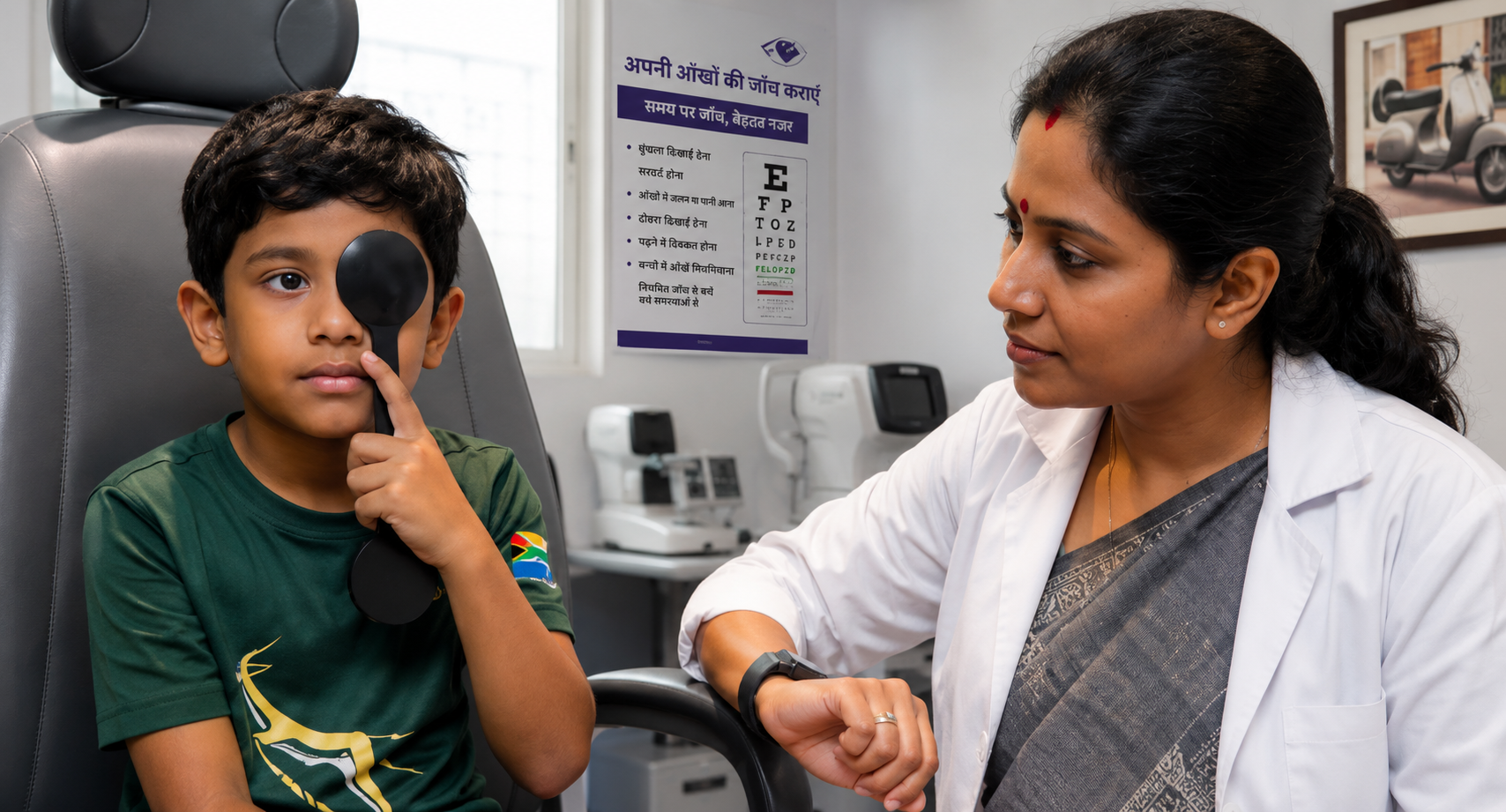
MYOPIA (Short-sightedness)
Myopia is a common refractive error in which distant objects appear blurred. It is increasingly seen in school-going children due to increased screen time and reduced outdoor activities. Early detection and myopia control can prevent high myopia and future eye complications.
What Causes Myopia?
- Genetics (family history of glasses)
- Excessive near work (reading, writing, screens)
- Limited outdoor play
- Increased screen exposure
Symptoms
- Blurred distance vision
- Squinting to see clearly
- Headaches or eye strain
- Sitting close to TV or books
Myopia Control Treatments at Rana Eye Centre
We offer evidence-based myopia control options to slow the progression safely and effectively:
- Atropine 0.01% Therapy: Proven to slow myopia progression
- Special Myopia Control Glasses: DIMS, HALT and other advanced lenses
- Ortho-K (Orthokeratology): Overnight lenses to reshape the cornea
- Lifestyle Modification Plan: Outdoor play, digital habits & posture correction
Why Choose Us?
- Complete myopia assessment
- Child-friendly environment
- Honest advice – no overtreatment
- Long-term follow-up & progression tracking
FAQs – Progressive Myopia in Children
For parents concerned about increasing glasses power
1. What is progressive myopia?
Progressive myopia means your child’s distance vision keeps worsening over time. Glasses power increases gradually, for example –1.00 to –2.50 to –4.00.
2. Why is myopia increasing so fast in children today?
Increased screen time, excessive near work, reduced outdoor play, and genetic factors all contribute to faster eye growth and myopia progression.
3. Is progressive myopia harmful?
Yes. High myopia increases lifelong risk of retinal detachment, myopic macular degeneration, glaucoma, early cataract, and structural weakness of the eye.
4. How do I know if my child has progressive myopia?
Warning signs include increasing glasses power every 6–12 months, reading too close, squinting, headaches, poor outdoor habits, and high screen use. A detailed eye exam with axial length measurement confirms progression.
5. Can myopia be reversed?
No. Once the eye elongates, it cannot shrink back. However, progression can be slowed effectively.
6. How can progressive myopia be controlled?
Control methods include low-dose atropine drops, myopia control glasses, orthokeratology lenses, and lifestyle changes such as increased outdoor play and reduced screen exposure. Combination therapy works best.
7. Is atropine safe for children?
Yes. Low-dose atropine (0.01–0.05%) is safe and widely used. Side effects are minimal and monitored closely by the doctor.
8. What are DIMS or myopia control lenses?
These are specially designed spectacle lenses that reduce peripheral blur, helping slow eye elongation while providing comfortable vision.
9. What is Ortho-K? Is it safe?
Ortho-K lenses are worn at night to temporarily reshape the cornea, allowing clear vision during the day. They are safe with proper hygiene and regular follow-up.
10. How often should my child be checked?
Usually every 6 months, or every 3 months if progression is rapid. Monitoring includes glasses power, axial length, and corneal health.
11. Will my child still need glasses?
Yes. Myopia control slows progression but does not eliminate the need for glasses. The goal is to prevent high myopia and future complications.
12. Does outdoor time really help?
Yes. At least 2 hours of outdoor play daily is proven to slow myopia progression.
13. What age is most critical?
Ages 5–15 years, when eye growth is fastest. Early intervention is most effective.
14. Can progressive myopia cause blindness?
Severe high myopia can lead to retinal tears, detachment, and macular degeneration, which may threaten vision. Early control reduces these risks significantly.
15. What is axial length and why is it important?
Axial length measures eye growth. Increasing length indicates myopia progression and is the most reliable monitoring tool.
16. What is the best treatment for my child?
Treatment depends on age, glasses power, axial length, eye health, and lifestyle. At Rana Eye Centre, we provide honest, individualized guidance for each child.